
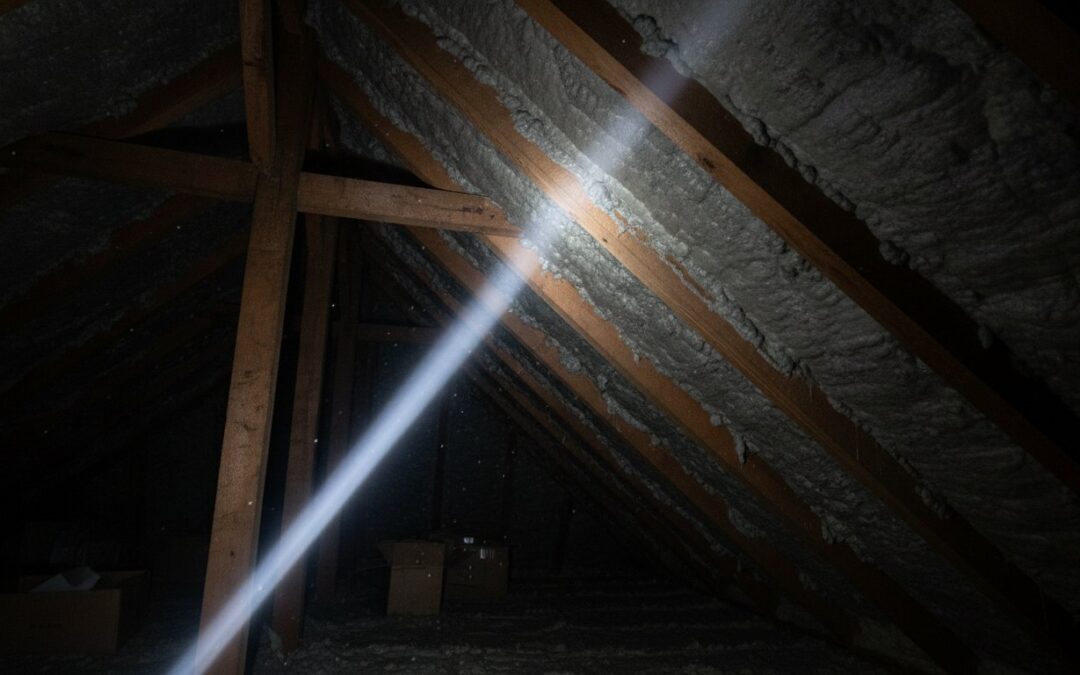
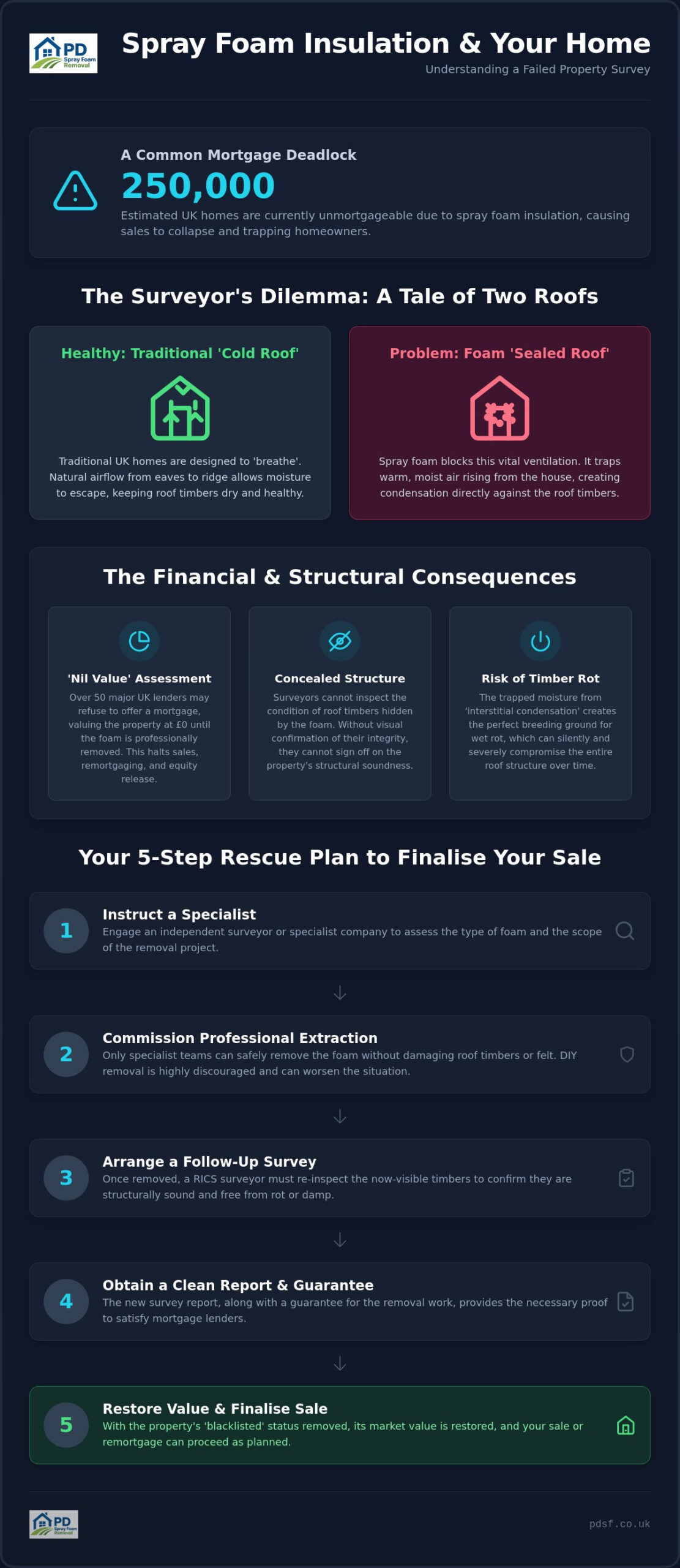
Just as the finish line appeared in sight, one homeowner recently discovered her house sale had hit a wall because her spray foam insulation survey failed. It’s a devastating phone call to receive, especially when the “eco-friendly” loft insulation you installed in good faith is suddenly classed as a high-risk defect. You might feel caught in a stressful loop of pressure from solicitors and estate agents, all while worrying if your roof timbers are suffering from hidden rot. This situation is increasingly common, with an estimated 250,000 homes across the UK currently caught in this specific mortgage deadlock.
We recognise the frustration of seeing a “green” product become a major financial barrier. This guide is designed to replace that anxiety with a clear, professional resolution. You’ll discover exactly why lenders are rejecting these applications and the specific steps required to satisfy their criteria. We’ll outline the process of professional extraction and how to secure a clean survey report, providing you with a reliable path to restore your home’s value and finally finalise your sale.
Key Takeaways
- Understand why major UK banks often issue a “nil value” assessment when a spray foam insulation survey failed and why professional removal is typically the only way to secure a mortgage.
- Learn about the structural risks of the “Cold Roof” dilemma and how trapped moisture can lead to interstitial condensation, putting your roof timbers at risk of rot.
- Discover why attempting a DIY removal can lead to further structural damage and why meticulous professional extraction is necessary to pass a follow-up survey.
- Follow a clear five-step rescue plan to manage the situation calmly, from instructing a specialist to obtaining the clean report required to finalise your sale.
- Find out how specialist removal restores your property’s market value and removes the “blacklisted” status that often prevents equity release and standard lending.
Why Your Property Survey Failed Due to Spray Foam Insulation
The moment a surveyor spots that thick, expanding layer in your loft, the tone of your property sale often changes instantly. It’s a frustrating situation because many homeowners were encouraged to install it under “green” initiatives or the Great British Insulation Scheme. However, if your spray foam insulation survey failed, it’s usually because the RICS (Royal Institution of Chartered Surveyors) professional has flagged the material as a high-risk feature that compromises the property’s mortgageability.
Whilst a “cautionary note” in a HomeBuyer Report might suggest a minor repair like a slipped tile, a failure regarding spray foam is far more serious. In many cases, it leads to a “nil value” assessment. This means the lender refuses to secure a loan against the property until the foam is removed. By July 2026, over 50 major UK lenders, including Halifax, Nationwide, and TSB, have tightened their criteria to the point of a de facto ban. They aren’t just being difficult. They’re protecting their security.
The RICS Position and Lender Caution
The primary issue for any surveyor is visibility. To provide a mortgage valuation, a professional must confirm the structural integrity of the roof. Because spray foam adheres directly to the roof felt and timbers, it creates a permanent barrier. Surveyors cannot see the condition of the wood behind it. They cannot check for rot, dampness, or woodworm. This “invisibility” is why 70-80% of UK mortgage lenders now refuse to lend on these properties. Before diving into the risks, it’s helpful to understand What is Spray Foam Insulation and why its application in residential lofts has become such a hurdle for equity release and remortgaging.
Installer Guarantees vs. Surveyor Standards
Many homeowners feel blindsided because they hold a 25-year installer warranty. Unfortunately, these guarantees rarely satisfy a mortgage surveyor. These warranties often cover the product’s performance but ignore the structural impact on the roof timbers. The original installation market suffered from a lack of independent regulation, leaving many lofts with inadequate ventilation. If your spray foam insulation survey failed, it’s often a blessing in disguise for the long-term health of your home. It highlights a moisture trap that, if left alone, could eventually necessitate a complete roof replacement. Professional extraction is the only verified way to clear these surveyor concerns and restore your home’s status as a mortgageable asset.
The Structural Risks: What Surveyors Are Actually Looking For
When a surveyor enters your loft, they aren’t just looking at the foam itself; they’re looking for what the foam is hiding. If your spray foam insulation survey failed, the professional is likely concerned about the “Invisible Hazard” argument. Because the material bonds directly to the structure, it’s impossible to verify if the rafters are bone dry or slowly disintegrating. Surveyors cannot see what they cannot touch. This lack of access is an automatic red flag for most RICS inspections.
Most older UK homes were built with a “cold roof” design. This traditional architecture relies on natural airflow from the eaves to the ridge to whisk away moisture. Spray foam often turns this into a sealed, stagnant environment. By blocking the natural breathability of the loft, the foam creates a conflict between the modern insulation and the original building materials. This “Cold Roof” dilemma is a primary reason why properties fail their valuation stage.
Interstitial Condensation and Roof Felt
When warm, moist air from your living spaces rises into the loft, it eventually hits the cold roof felt. In a healthy roof, this moisture would evaporate or vent out through the tiles. However, foam applied directly to the felt traps this moisture at the “dew point” within the roof structure. Interstitial condensation is the primary cause of timber rot in foamed lofts as it allows water to settle deep within the wood fibres where it cannot dry out. According to a House of Commons Library report, these structural concerns are the driving force behind the current mortgage lending crisis. The damp environment becomes a breeding ground for wet rot, which can quietly compromise the entire roof over several years. In such cases, mould growth often follows, and specialists like MouldMen can provide guidance on identifying and treating these issues before they compromise your home’s air quality.
Timber Health and Rafter Integrity
Surveyors look for subtle signs of rafter stress that indicate the wood is under pressure. This might include sagging ridge lines or damp staining near the eaves where the foam meets the masonry. Closed-cell foam is particularly problematic in this regard. Its rigid, dense nature can actually mask structural cracks or previous leaks, making it a hidden danger for the next owner. If your spray foam insulation survey failed, it’s often because the surveyor cannot guarantee the timber health beneath that dense layer. Ignoring these signs until the rafters fail can lead to repair costs far exceeding simple extraction. A professional roof inspection is often the first step in determining exactly how much moisture has been trapped and what needs to be done to save the sale.
Mortgage Lenders vs. Spray Foam: Why Removal is the Only Path
Imagine you’ve found the perfect buyer and everything is moving smoothly until the lender’s valuation report arrives. If your spray foam insulation survey failed, you’ve likely encountered the “Zero Tolerance” policy adopted by most high-street banks. In 2026, the lending environment hasn’t softened. Over 50 major UK lenders, including Halifax, Nationwide, and HSBC, continue to view spray foam as a fundamental risk to their security. They aren’t interested in whether the installation was well-intended. They see a property that might be impossible to sell in the future if timber rot sets in.
Lenders like Nationwide and HSBC have maintained a firm stance because their surveyors cannot guarantee the condition of the roof for the duration of a 25 or 30-year mortgage term. If your spray foam insulation survey failed, it’s often because the bank’s valuer has flagged the property as “unmortgageable in its current state.” This isn’t a reflection of your home’s cleanliness or decor; it’s a cold, financial calculation regarding the risk of future structural decay. Professional extraction is the only way to clear the title and provide the “clean slate” that allows a positive valuation to proceed.
The Cost of Justification vs. The Certainty of Removal
You might be tempted to commission a “specialist foam survey” to justify the installation. These reports can be expensive, often costing several hundred pounds. The risk is high. You could pay for a specialist to say the foam is fine, only for the lender to reject the report anyway. High-street banks rarely accept third-party assessments that contradict their own surveyor’s caution. Lenders are increasingly wary of these “middle-ground” reports. They prefer the binary certainty of a clear loft. When the foam is gone, the risk is gone. Investing in professional removal replaces a gamble with a solution that every lender understands and accepts.
Satisfying Equity Release Providers
Retirees often face the toughest hurdles in this market. Equity release providers are even more risk-averse than standard lenders because they are in it for the long haul. Currently, almost no equity release lenders will approve a plan on a property where spray foam was retrofitted after the original build. For many, this freezes their primary source of retirement funding. A professional certificate of removal is the key that unlocks this door. It proves the loft has been restored to its original, breathable state, allowing the equity release process to resume without further delay and restoring the full market value of the asset.
Your 5-Step Rescue Plan After a Failed Home Survey
Receiving a report stating that your spray foam insulation survey failed feels like a deal-breaker, but it is actually a manageable hurdle. Most property chains collapse because of uncertainty, not the physical presence of the foam itself. By following a structured rescue plan, you can provide the transparency lenders require and keep your buyers at the table. This proactive approach replaces panic with a professional timeline that satisfies solicitors and estate agents alike.
Step 1: Don’t Panic. Acknowledge the surveyor’s report as a standard industry reaction to a known risk. It isn’t a personal judgement on your property maintenance. Step 2: Instruct a Specialist. Secure a detailed quote for professional spray foam removal as soon as possible. This gives you a concrete figure to work with during negotiations. Step 3: Negotiate the Sale. Use this quote to adjust the sale price or agree on a financial retention. Step 4: Professional Extraction. This involves the physical stripping of the foam and a meticulous cleaning of the roof timbers. Step 5: Post-Removal Inspection. Secure the final sign-off that proves the “invisible hazard” has been eliminated, allowing the lender to proceed with a positive valuation.
Negotiating with Buyers and Sellers
Time is your enemy in a property chain. If you wait weeks to address the survey findings, your buyer might lose confidence and withdraw their offer. Presenting a professional removal quote immediately shows you are taking the structural integrity of the home seriously. Common industry practice often involves the seller covering the cost of removal or splitting it with the buyer through a price reduction. This transparency keeps the mortgage application alive and prevents the “nil value” assessment from stalling the process indefinitely. Acting quickly often saves the chain from collapsing entirely, though some sellers prefer a direct route via lpsrealestategroup.com, which focuses on property acquisitions through cash offers and creative finance solutions.
The Post-Removal Paperwork
Physical removal is only half the battle. To satisfy a high-street lender in 2026, you need a robust paper trail. A valid “Certificate of Removal” must detail the methods used and confirm that the timbers are now fully visible and accessible for future inspections. Photographic evidence of the cleaned rafters is essential. It provides the visual proof that the moisture trap has been removed. Your solicitor will need to liaise directly with the buyer’s legal team to ensure this documentation is accepted, allowing the mortgage offer to be formally issued and the sale to move toward completion.
Professional Extraction: Restoring Your Home’s Value and Saleability
The moment you decide to remove the foam is the moment you take back control of your property sale. While discovering that your spray foam insulation survey failed is a significant setback, the physical extraction process is the turning point that leads to a successful completion. It isn’t merely about clearing out a loft; it’s about restoring the structural integrity and the “mortgageable” status of your home. A professional approach ensures that the rafters are returned to their original state, satisfying even the most cautious RICS surveyor.
Attempting a DIY removal is a high-risk strategy that often backfires. Spray foam is incredibly adhesive. Without specialist tools and techniques, homeowners frequently gouge the timber rafters or leave behind significant residue. If a surveyor returns and sees foam remnants or damaged wood, they’ll likely fail the survey a second time. Professional extraction provides the meticulous finish required to prove the moisture trap is gone for good. It’s the difference between a “managed risk” and a total resolution that restores your property’s market value and lowers future insurance premiums.
The Professional Removal Process
Our approach prioritises the safety of your home and the health of its structure. Extracting foam is a messy, labour-intensive task that involves handling fine particles and, in some cases, toxic dust from older installations. We use industrial-grade vacuums and protective screening to ensure these particles don’t migrate into your living spaces. A critical part of the process is rafter “shaving” and cleaning. We meticulously scrape the timber to ensure no residue remains, as even small patches of foam can hide moisture or be flagged by a valuer. All materials are then disposed of in strict accordance with UK environmental regulations, leaving you with a clean, breathable loft space.
Next Steps: Re-insulating and Moving Forward
Once the extraction is complete, the goal is to return the loft to a traditional, lender-approved state. This usually involves installing mineral wool or glass fibre batts at the joist level. These materials are favoured by surveyors because they provide excellent thermal performance whilst allowing the “Cold Roof” ventilation to function exactly as designed. This restoration of airflow is vital for preventing future rot and ensuring the long-term health of your roof timbers. Taking this step doesn’t just save your current sale; it provides permanent peace of mind for you and any future owners. Get a professional quote for spray foam removal today to clear the final hurdle in your property journey.
Secure Your Sale and Protect Your Property Value
Discovering that your spray foam insulation survey failed is a significant hurdle, but it doesn’t have to be the end of your property sale. We’ve explored how lenders prioritise the long-term health of roof timbers and why professional extraction is the only verified method to satisfy their strict criteria. By choosing a specialist approach, you replace structural uncertainty with the clear, documented proof that surveyors and banks require to move forward.
At PD Spray Foam Removal, we provide a national service across the UK, using specialist extraction techniques that protect your roof rafters whilst ensuring every trace of residue is gone. We don’t just clear your loft; we provide the comprehensive documentation needed to satisfy mortgage lenders and restore your home’s marketability. Don’t let a failed survey stall your future plans. Request your professional spray foam removal quote from PD Spray Foam Removal today and take the final step toward a successful completion. You’ve worked hard to build your home’s value; we’re here to help you secure it.
Frequently Asked Questions
Can I just remove the spray foam myself to save money?
DIY removal is strongly discouraged because it often leads to structural damage or incomplete extraction. If any residue remains on the timbers, your surveyor will likely conclude the spray foam insulation survey failed for a second time, wasting both your time and money. Professional tools and specialised techniques are necessary to clean rafters thoroughly without gouging the wood or damaging the roof felt.
Will my mortgage be approved immediately after the foam is removed?
Approval isn’t instantaneous, but removal clears the primary hurdle that causes lenders to reject applications. Once the foam is gone, you’ll need to submit a professional certificate of removal to your lender. They will typically instruct a valuer to revisit the property to confirm the timbers are visible, allowing them to lift the “nil value” assessment and proceed with the offer.
How long does a professional spray foam removal take?
A standard three-bedroom semi-detached house typically takes between two and four days to clear completely. The exact timeframe depends on whether you have open-cell or the much denser closed-cell foam. Accessibility within the loft and the pitch of your roof also play a role in how quickly our specialists can safely complete the extraction and cleaning process.
Does removing spray foam cause damage to my roof tiles?
Professional extraction focuses entirely on the internal structure and shouldn’t affect your roof tiles or external coverings. We work meticulously from the inside of the loft to strip the foam away from the rafters and the underside of the roof. Unqualified firms or DIY attempts are much more likely to tear the breathable membrane or displace tiles through improper handling.
Why did my surveyor only flag the foam now when it has been there for years?
Surveyors are following updated RICS guidance and much stricter lender policies that didn’t exist when the foam was originally installed. While the insulation hasn’t changed, the banking industry’s appetite for risk has shifted significantly. Over 50 major UK lenders now refuse to secure loans against these properties to protect their long-term security against potential timber decay.
Can I get a mortgage if only a small amount of spray foam is present?
Most high-street lenders maintain a zero-tolerance policy regardless of the quantity of foam present. Even a small amount prevents a surveyor from seeing the full condition of the roof timbers and checking for moisture. To satisfy a mortgage provider in the current market, the loft usually needs to be completely clear of all spray-applied insulation products.
What documentation do I need to show my lender after removal?
You will need a formal Certificate of Removal along with a comprehensive set of photographic evidence showing the cleaned, bare rafters. It’s also vital to provide a waste transfer note to prove the materials were disposed of in accordance with environmental regulations. These documents provide the professional paper trail your solicitor needs to satisfy the lender’s legal requirements.
Is open-cell spray foam easier to pass in a survey than closed-cell?
Both types are currently treated with equal caution by the majority of UK mortgage lenders. While open-cell foam is technically more breathable, it still obscures the rafters from a surveyor’s view. If your spray foam insulation survey failed, the specific type of foam matters less than the fact that it’s preventing a clear structural assessment of the roof’s integrity.